How To Build A Trading Bot Without A Strategy
No trading strategy? No problem. Learn how to build a crypto trading bot using verified, live-tracked strategies from AlphaInsider.


You do not need your own trading strategy to run a trading bot. In fact, if you're new to automated trading, you probably shouldn't use your own — because your strategy is likely a guess.
Here's the alternative: experienced traders are publishing their strategies on a public marketplace with live track records showing every single trade. Not screenshots. Not edited backtests. Real, verified results you can inspect before you put a single dollar on the line.
The process is simple. You pick a strategy that's actually working, connect it to your own brokerage account, and the bot copies every trade for you automatically. Your money never leaves your brokerage.
In this guide, we'll build a diversified crypto trading bot from scratch — with three strategies running side by side — and walk through exactly how it places its first trades.
Table of Contents
- Why You Don't Need Your Own Strategy
- The Problem With AI-Built Trading Strategies
- What Is the Strategy Marketplace?
- Prerequisites: What You'll Need
- How to Find Strategies Worth Automating
- How to Read a Strategy's Verified Track Record
- Step-by-Step: Build Your Trading Bot
- How to Diversify Across Multiple Strategies
- Not Ready to Automate? Use Alerts First
- Tips and Best Practices
- Common Mistakes to Avoid
- Frequently Asked Questions
- Conclusion
Key Takeaways
- You don't need to build your own strategy. Thousands of live-tracked strategies are available to copy on the AlphaInsider marketplace.
- Verified track records beat backtests. Every trade is tracked live in real time — no curve fitting, no repainting, no editable screenshots.
- Your funds stay put. API keys allow trades to be placed on your behalf, but never grant withdrawal permissions.
- Diversification matters most. Running multiple strategies in one bot spreads your risk — something few automation tools actually support.
- Rebalancing is automatic. Add a strategy with open positions and your bot adjusts your account to match.
- Crypto trades 24/7. Stock automation requires a $2,000 minimum for a margin account.
- Your first strategy automates free with an AlphaInsider account.
Why You Don't Need Your Own Strategy
The biggest misconception in automated trading is that you must invent your own edge before you can build a trading bot. You don't.
If you're just starting out, your homemade strategy is probably an untested guess — a set of rules that feel right but have never survived contact with a real market. Meanwhile, experienced traders are already publishing strategies with every trade tracked live and publicly visible.
That means you can see:
- What's working right now, not just what worked in a cherry-picked window.
- How the strategy has performed historically, across years of real market conditions.
- Exact entry and exit timestamps and price points for every single trade.
You get to evaluate the evidence before you commit capital. That's a fundamentally better starting point than trusting logic you wrote last weekend.
The Problem With AI-Built Trading Strategies
Right now there's enormous excitement about using AI agents and tools like Claude or ChatGPT to generate trading logic and remove yourself from the analysis and button-pressing. That excitement is warranted — but there are two glaring problems nobody talks about.
Problem 1: Running multiple strategies on one account is hard. Most automation setups only handle a single strategy. Getting several strategies to trade the same account without stepping on each other is genuinely difficult, and it's the exact thing you need for diversification.
Problem 2: You have no track record. If you generate a strategy with AI, you probably have no data on how it actually performs. You might build a Monte Carlo simulation or run a backtest — but do you truly know it will trade like the backtest?
Two well-known traps make that a real risk:
| Trap | What it means |
|---|---|
| Curve fitting | The strategy is over-optimized to past data and falls apart on new data. |
| Repainting | Indicator signals appear or shift after the fact, making historical results look better than they were. |
A marketplace of live-tracked strategies eliminates both concerns, because you're not looking at a simulation — you're looking at trades that actually happened, in real time, at real prices.
To be clear: this doesn't mean a strategy can't implode. Anything can happen in markets. But at least you have a real track record to rely on before turning over the keys.
What Is the Strategy Marketplace?
Everything in this guide happens on alphainsider.com, a platform that currently has:
- Over $10 million in broker-connected assets
- Over 15,000 users
- Over 5,000 trading strategies — all tracked live, with the count climbing daily
The heart of the platform is the strategy marketplace. Scroll through and strategies load continuously. Click into any one and you'll see detailed performance data, and often a description that links out to TradingView.
That TradingView link is a bonus for more advanced users: you can grab the Pine Script source code, edit it, customize it with AI, and make it your own to run on whatever assets you choose. But that's entirely optional — you can copy strategies as-is and never touch a line of code.
Prerequisites: What You'll Need
| Requirement | Details |
|---|---|
| AlphaInsider account | Free to create; your first strategy automates at no cost. |
| A brokerage account | HyperLiquid is used in this walkthrough for crypto. Alpaca is an option for stocks. |
| Funded account | Crypto: fund your HyperLiquid account. Stocks: $2,000 minimum for a margin account. |
| Public and private API keys | From your broker — these allow trades on your behalf, with no withdrawal permissions. |
| A few strategies you like | Found and vetted through the marketplace. |
Skill level: Beginner-friendly. No coding required.
Time estimate: You can go from browsing to a live, rebalanced bot in roughly 15–30 minutes.
On the stock minimum: The margin account minimum used to be $25,000. It's now down to $2,000, which gives you access to margin (leverage) and the ability to day trade in and out as many times as you'd like.
How to Find Strategies Worth Automating
The marketplace can feel overwhelming at first. The search and sort tools make it manageable. Here's the filtering approach that works:
- Filter by asset class. Sort by crypto (or stocks) depending on the bot you're building.
- Set a minimum trade count. Filtering for strategies with at least 20 trades removes thin, unproven records and leaves you with more active strategies.
- Sort by performance. Now you have a ranked list of active strategies, best to worst.
- Change the time frame. This is the step most people skip — and it changes everything.
Why the time frame matters: Over the past year — and especially the past six months — crypto has not been kind. Any strategy showing a profit in that window is already a good sign. But zoom out to five years and the picture transforms: strategies showing 100%, 317%, 365%, and even 500% returns appear on the chart.
Watch the trade dots. Every dot on a strategy's chart represents a trade taken. Some strategies look great on paper but haven't fired a trade since 2024. They either went inactive, or their logic has simply kept them sitting out.
If you want an active trading bot, skip the dormant strategies — no matter how good their historical numbers look.
How to Read a Strategy's Verified Track Record
Before adding any strategy to your bot, click into it and scroll down to the verified trades section. This is where the marketplace earns its value.
You can:
- See every verified trade the strategy has taken.
- Hover over any date to see the exact time the trade went live.
- Review the precise price points for entries and exits.
This is real evidence, tracked in real time. Compare that to an AI-generated strategy where you have nothing but a backtest you can't fully trust.
Also check whether the strategy has a description or a TradingView link. Reading the underlying logic before you commit is strongly recommended. At the end of the day performance is performance, and you may choose to skip that step — but more research is always better.
Step-by-Step: Build Your Trading Bot
Here's the full build, from marketplace to live positions.
-
Find a strategy you want to automate. Use the filters above, then click into the strategy to review its verified trade history.
-
Subscribe (optional). Subscribing saves the strategy to your subscriptions list in the top right, which makes it easy to search later. Note that you don't technically have to subscribe to auto trade a strategy — you can click Auto Trade directly and it will prompt you to create a new bot.
-
Click Auto Trade. This starts the bot setup flow.
-
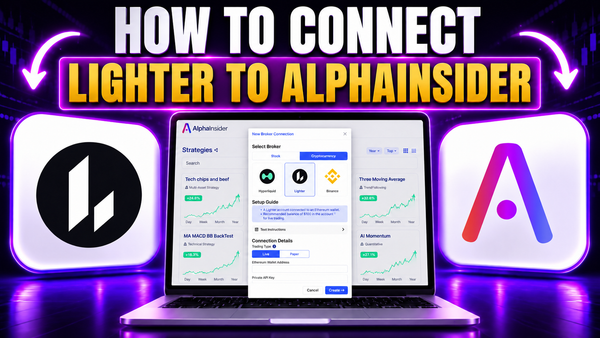
Create a new broker connection. If you don't already have one, select your broker. This walkthrough uses HyperLiquid for crypto.
-
Fund your broker account and add your API keys. Enter your public and private API keys. These allow actions to be performed on your behalf without granting withdrawal permissions — your money never leaves your brokerage.
-
Set your allocation. You'll land on a page where you specify how much of your account goes to this strategy. Since the goal here is three strategies, enter 33%. You can also allocate by dollar amount instead of percentage if you prefer.
-
Click Save. Your bot immediately rebalances based on the strategy's current positions.
-
Verify the position. If the strategy is currently long ETH, your bot will open a long ETH position — and because it's the only strategy in the bot at this point, ETH will be your only position. Any prior unrelated positions get cleaned out during the rebalance.
From here you can monitor your balance and performance over time directly on the bot page.
How to Diversify Across Multiple Strategies
Running one strategy means you're fully exposed to one set of rules. Adding more is where the real advantage kicks in.
- Click New Allocations on your bot.
- Search your subscriptions (or your portfolio, if you've imported your own strategies — a more advanced route).
- Or go back to the homepage for better visuals: sort by crypto, set the time frame to five years, sort by performance, and browse.
- Click Auto Trade on your next pick and add it to your existing bot.
- Assign 33% to the second strategy, then repeat for a third. You can't exceed 100% total.
- Click Save and watch the bot rebalance across every position in every strategy.
Once rebalancing finishes, check your broker account and you'll see all the positions from all three strategies — opened for you automatically. You didn't place a single trade manually.
From that point on, the bot handles everything: balancing as new trades fire and positions close, 24/7, without you doing anything.
A note on allocation discipline: Things rarely go straight up forever. If one strategy is dramatically outperforming everything else, consider lowering your allocation to it. That lets you spread risk across other strategies and effectively take some profit off the table rather than staying overweight in a single strategy.
Not Ready to Automate? Use Alerts First
If full automation feels like too big a leap, there's a middle step. Click the notification bell icon on any strategy and you'll get alerted every time it takes a trade.
This lets you trade manually, learn how a strategy behaves, and build confidence before handing over the keys.
But be realistic about timing. Crypto strategies fire around the clock — one trade at 11:00 a.m., the next at 5:00 a.m. If you're asleep, you won't get the same fills. So:
- If a strategy takes a lot of overnight trades, it's probably better to automate it.
- If you're not willing to automate yet, pick a strategy whose schedule you can realistically stay on top of.
Tips and Best Practices
- Filter by minimum trade count (20+) to weed out thin, unproven records.
- Always zoom out to five years. A one-year view can badly misrepresent a strategy during a rough market stretch.
- Check the trade dots for recency. A strategy that hasn't traded since 2024 won't give you an active bot.
- Read the verified trade log, including exact timestamps and prices, before allocating.
- Follow the TradingView link when one exists to understand the actual logic.
- Trim your winners' allocations when one strategy runs far ahead of the rest.
- Use alerts as training wheels if you're not ready to fully automate.
Common Mistakes to Avoid
- Believing you need your own strategy. You don't — and as a beginner, a proven one is usually the better choice.
- Trusting an AI-generated strategy with no track record. Curve fitting and repainting can make a backtest look far better than reality.
- Putting everything into one strategy. Single-strategy bots concentrate all your risk in one place.
- Judging only on the one-year chart. Market conditions in any single year can mask a strategy's real long-term profile.
- Adding dormant strategies. Great historical returns mean nothing if the strategy stopped trading years ago.
- Chasing the hottest performer. Nothing goes up forever; consider reducing allocation to extreme outperformers.
- Assuming a track record guarantees future results. Any strategy can implode — a verified record is evidence, not a promise.
Frequently Asked Questions
Can I run a trading bot without my own strategy?
Yes. You can browse thousands of live-tracked strategies on the AlphaInsider marketplace, pick ones with proven records, and have your bot copy every trade automatically.
Does AlphaInsider have access to my money?
No. Your funds stay in your own brokerage account. The public and private API keys you provide allow trades to be placed on your behalf but carry no withdrawal permissions.
Why not just build a strategy with AI?
You can — but you likely won't have a real track record. Backtests can be undermined by curve fitting and repainting, so you can't be sure the strategy will trade the way the backtest suggests. Marketplace strategies show live, verified trades instead.
How many strategies can I put in one bot?
You can run multiple strategies in a single bot and split your account between them by percentage or dollar amount, up to 100% total. This walkthrough uses three at roughly 33% each.
What happens when I add a strategy that already has open positions?
Your bot automatically rebalances and opens those positions in your account on your behalf. You don't place any trades manually.
Do I need to subscribe to a strategy to automate it?
No. Subscribing just saves it to your list for easy searching later. You can click Auto Trade directly and it will prompt you to create a bot.
What's the minimum to automate stocks?
You need $2,000 in your account, which is the current minimum for a margin account. It used to be $25,000. That gives you access to margin and unlimited day trading.
Can I customize a strategy's code?
Sometimes. If a strategy links out to TradingView, you can grab the Pine Script source, edit it, customize it with AI, and run your own version on the assets you choose.
Is any of this free?
Yes — you can create an AlphaInsider account for free and automate your first trading strategy at no cost.
Can a marketplace strategy still lose money?
Absolutely. A verified track record tells you what has happened, not what will happen. Any strategy can stop working, which is exactly why diversifying across several is so important.
Conclusion
Building a trading bot without a strategy isn't a shortcut — it's arguably the smarter starting point. Instead of trusting untested logic or an AI-generated backtest you can't verify, you're copying strategies with live, real-time track records you can inspect trade by trade.
Pair that with the ability to run several strategies in a single bot, allocate by percentage, and rebalance automatically, and you get something genuinely rare: diversified automation that doesn't require you to write a line of code or place a single manual trade.
Do your research, spread your risk, monitor your allocations, and stay realistic about what any strategy can deliver.
Ready to build yours? Create a free AlphaInsider account, connect your broker, and automate your first trading strategy at no cost. Happy trading.