AI Trading Bots Explained: Why Most Won't Work in 2027
AI makes trading bots easy to build, but a bot that runs isn't a bot that makes money. Here's what the data shows and how to test first.

AI has made building a trading bot easier than ever. You can describe a strategy in plain English, and an AI platform will write the code, host it, and send the alerts for you. That convenience hides a costly mistake many traders will make heading into 2027.
The mistake is confusing a trading bot that runs with a trading bot that makes money. You can automate a bad strategy just as easily as a good one. This guide to AI trading bots explains the difference between a strategy and a bot, shows what real data from AlphaInsider reveals about winning and losing strategies, and lays out the testing process to complete before you put real money behind any bot.
The short answer: most AI trading bots won't work because they automate strategies that were never proven. Backtest, forward test in live market conditions, and size your risk before you automate anything.
Table of Contents
- Key Takeaways
- What Are AI Trading Bots, Really?
- What a Trading Bot Actually Does
- Why Traders Really Lose Money
- How AI Made Building Bots Easier
- What the Data Says About Most Strategies
- Bad Example: Frequent Trading Eaten by Fees
- Good Example: Big Returns With Big Drawdowns
- Build a Bot That Survives Volatility
- Backtest Strategies With AI
- Forward Test Before You Risk Real Money
- A Testing Checklist Before You Automate
- Frequently Asked Questions
- Conclusion
Key Takeaways
- Automation does not equal profitability. A bot executes rules perfectly, including bad rules.
- A strategy and a bot are not always the same thing. A true trading bot can run several strategies on one account with different allocations.
- Emotion and simple mistakes blow up more accounts than bad strategies do. Removing emotion is one of the biggest benefits of automation.
- Only about one in six strategies passed a basic screen out of just under 1,000 public strategies reviewed on AlphaInsider.
- High trading frequency correlated with poor performance. One crypto strategy with 212 days of trading activity in a year was down 87%.
- Profitable strategies can still carry huge drawdowns. One strategy was up 129% in a year with a 39% max drawdown, and 72% over five years.
- Backtest, then forward test. Check for curve fitting and repainting, then let the strategy trade live before you commit capital.
What Are AI Trading Bots, Really?
Before you build anything, separate two ideas that people constantly mix up: the trading strategy and the trading bot. Many traders treat them as the same thing. Sometimes they are, but often they are not.
- A trading strategy is a set of rules: when to buy, when to sell, where to place a stop loss, and where to take profit.
- A trading bot is the automation that executes those rules. If you automate a single strategy, many people will call that a trading bot.
The line blurs when you combine strategies. You can run multiple trading strategies that each do something different inside one trading bot, trading a single account with a different allocation to each strategy. That is a much more complex system, and it is what a trading bot truly is.
Understanding this difference matters. When you evaluate AI trading bots, you are really evaluating two layers: whether each strategy has an edge, and whether the bot combines them in a way that manages risk.
What a Trading Bot Actually Does
At its core, a trading bot follows set criteria defined ahead of time and acts on them the same way every time those criteria are met. You decide the logic once, and the bot repeats it over and over without you having to press a button.
The logic can be very simple. Consider a strategy built just a few weeks before the video was recorded, a Tesla weekend strategy:
- Buy Tesla at the end of the trading week.
- Sell it at the start of the next week.
- Repeat every week.
It is admittedly a basic idea, but it has done fairly well over the past couple of weeks. The point is not that this specific strategy is special. The point is that a bot turns any rule set into consistent, repeatable action, whether that rule set is good or bad.
Why Traders Really Lose Money
One of the biggest reasons people lose money in trading is that they let emotions control their decisions. The pattern is familiar:
- They follow the rules for a while and trade correctly.
- They hit a losing streak.
- They get emotional and start changing the strategy.
- They double down, sell early, or move their stop loss.
At that point, they are no longer trading the strategy they tested. If they backtested it, the results they are living through now come from something completely different.
Your Strategy May Be Closer to Break Even Than You Think
Here is a counterintuitive idea: you are probably much closer to breaking even with your strategy than you realize. If you had an idea, examined it, and backtested it, whether manually, in TradingView, or with other backtesting software, you likely found it was profitable or had a good reason to trade it. Fees can change that picture, but the strategy itself is often not the main problem.
What usually blows accounts is human error:
- A big losing streak that triggers emotional decisions
- Clicking buy instead of sell
- Adding an extra zero to position size
- Trading while angry or distracted
This is exactly where automation shines. A bot does not get frustrated, does not fat-finger an order, and does not abandon its rules after a bad week.
How AI Made Building Bots Easier
Building a bot used to require real programming skill. Today, AI can build the code for you, and you can even build trading strategies directly inside your AI platform of choice. The AI can:
- Build the strategy
- Host the strategy
- Send alerts where they need to go
- Handle the hard work without you writing a single line of code
All you need is a clear description. For example: "I want a strategy that buys when the 5 EMA crosses over the 26 EMA. Every time it happens, put my stop loss here and set my take profit here." If you can put your idea on paper, AI can build it.
That is great news, but it is also the trap. Because it is so easy to automate, many traders will automate untested ideas and assume that a bot that runs is a bot that works.
What the Data Says About Most Strategies
So how do you know whether you have a good strategy or a bad one? To find out, the AlphaInsider skill was installed into an AI tool and asked to review all of the public strategies on the platform, looking for patterns that separate good performers from bad ones.
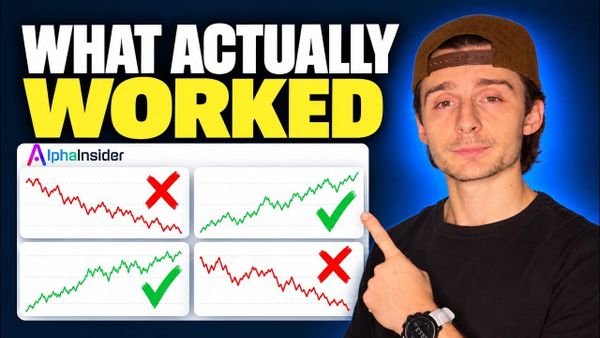
Out of just under 1,000 trading strategies, only about one in six passed two screens:
| Strategy type | Screen it had to pass | Market context |
|---|---|---|
| Stock strategies | Beat the S&P 500 over the past year | Benchmark buy and hold |
| Crypto strategies | Finish the year profitable | Bitcoin was down 30% that year |
The takeaway is clear: most trading strategies do not beat simply buying and holding the S&P 500 for stocks or Bitcoin for crypto.
Why This Data Is Trustworthy
Every strategy on AlphaInsider is verified and cannot be edited after the fact. No one can go back and change trades, so the data shows how strategies actually traded, not how their creators wish they had traded.
Bad Example: Frequent Trading Eaten by Fees
Among the poor performers, the review found a strong correlation between high activity and poor performance.
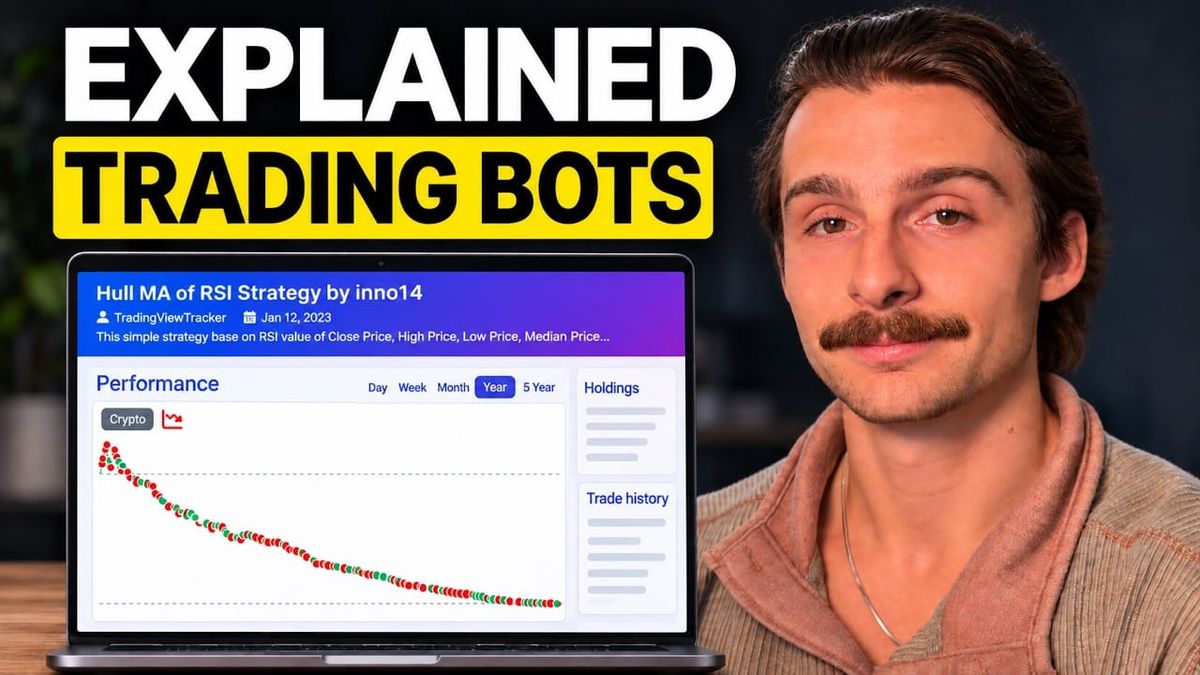
One example was a moving average of RSI crypto strategy running under the TradingView tracker account on AlphaInsider:
- 212 days of recorded trading activity over the one-year period reviewed
- Returns of down 87%
That is a terrible result. Realistically, if you were six months into trading it, you would probably notice it was a consistent loser and start looking for the cause.
Frequent trading alone does not doom a strategy, and not every active strategy loses money. But this one is a textbook case of a strategy with no edge being eaten alive by fees because of how often it trades.
Want to know if your bot really works?
Create a free AlphaInsider account and forward test your strategy in live market conditions.
Good Example: Big Returns With Big Drawdowns
There are plenty of profitable strategies too, but every profitable strategy has positives and negatives. One example was up 129% over the past year. The equity curve looked excellent.
However, it had a max equity drawdown of 39% over that same year. Max drawdown measures the biggest drop from a high point to a low point.
Here is what that means in dollars:
- You have $10,000 at the high water mark.
- The strategy hits its 39% drawdown.
- If all your money was in that one strategy, you would be down to $6,100 at one point.
That is a big swing. Strong overall results do not mean the ride is smooth.
Zooming Out Tells a Bigger Story
Looking at one year might make you think the strategy is a winner. Zoom out to five years, and the story gets more concerning:
| Timeframe | Performance | Max drawdown |
|---|---|---|
| Past one year | Up 129% | 39% |
| Past five years | Up hundreds of percent | 72% |
A 72% max drawdown is substantial. It does not mean you cannot trade the strategy. It means you must understand that risk before you automate it with your trading bot. If you put your entire account into this strategy on leverage, you will probably blow up at some point.
Build a Bot That Survives Volatility
This is where the difference between a strategy and a bot becomes powerful. Instead of putting everything into one volatile strategy, you can split your account across several strategies:
- One portion trades the high-return, high-drawdown strategy.
- Another portion trades something more stable.
- Another portion trades something different again.
Now you are building a trading bot designed to handle volatility. It can get through the larger drawdowns of individual strategies, survive, and still capture their upside without absorbing the full downside.
Backtest Strategies With AI
AI can help dramatically here. AlphaInsider built a free strategy creator skill for AI so you can build strategies and backtest them before trading live. A good backtest helps you see:
- Drawdowns the strategy experienced
- How profitable it was
- Win rate
- Whether it beat buy and hold
Why Backtests Alone Are Not Enough
A positive backtest does not guarantee a winning strategy. Many traders will tell you TradingView backtests are worthless, and any backtest can be misleading depending on several factors:
- Is it overly curve fit? A strategy tuned too tightly to past data often fails on new data.
- Is it repainting? Some indicators change past signals after the fact, making backtests look better than reality.
The good news is that you can now ask AI to double-check these issues before you automate a strategy.
Forward Test Before You Risk Real Money
The most important step is to let a strategy trade live in real market conditions for a period of time before funding it.
Say your TradingView backtest looks almost too good to be true. Here is how to find out how it really trades:
- Set up a webhook alert in TradingView for your strategy.
- Send every alert to a strategy on AlphaInsider each time the strategy fires.
- Track when each alert fired and at what price.
- Watch how the strategy performs over time in live conditions.
If your backtest showed the strategy up 100% last year, but it performs very differently when trading live, you have found a problem. Go back to the source code and the backtest, and make adjustments before you ever put real money behind it.
This is the biggest takeaway from the video: forward testing exposes the gap between what a backtest promises and what a strategy actually delivers.
A Testing Checklist Before You Automate
Automating trading strategies has never been easier, and there are countless ways to do it. But much of what you see on social media is misleading, because automating does not mean profitability. Before you automate any AI trading bot, work through this checklist:
- Separate strategy from bot. Know which rules you are testing and how the bot will allocate across them.
- Backtest the strategy for drawdowns, profitability, win rate, and performance versus buy and hold.
- Ask AI to check for curve fitting and repainting.
- Account for fees, especially for strategies that trade frequently.
- Forward test in live market conditions by sending alerts to a tracked strategy.
- Compare live results to the backtest, and fix the source code if they diverge.
- Size your risk so no single high-drawdown strategy can blow up your account, and avoid going all in on leverage.
- Only then automate with real money.
AI makes each of these steps faster, but if you want long-term results, you still cannot skip them.
Frequently Asked Questions
Why won't most AI trading bots work?
Most AI trading bots won't work because they automate strategies that were never properly tested. A bot executes rules perfectly, so it will run a losing strategy just as reliably as a winning one.
What is the difference between a trading strategy and a trading bot?
A trading strategy is a set of rules for entries, exits, stop losses, and take profits. A trading bot is the automation that executes them. A true trading bot can combine several strategies on one account with different allocations.
Can AI build a trading bot without coding?
Yes. You can describe your strategy in plain English, such as an EMA crossover with a defined stop loss and take profit, and AI can build the code, host the strategy, and send alerts without you writing any code.
How many trading strategies actually beat the market?
In a review of just under 1,000 public strategies on AlphaInsider, only about one in six beat the S&P 500 over the past year for stocks or finished profitable in a year when Bitcoin fell 30% for crypto.
Does trading more often lead to better returns?
Not necessarily. The review found a high correlation between frequent activity and poor performance. One crypto strategy that traded on 212 days in a year was down 87%, largely because fees ate it alive.
What is max drawdown and why does it matter?
Max drawdown is the largest drop from a high point to a low point. A 39% drawdown would turn $10,000 into $6,100 at its worst, so you need to know a strategy's drawdown before you automate it.
Are TradingView backtests reliable?
Backtests can be useful but are not guaranteed. They can be misleading if a strategy is overly curve fit or uses repainting indicators. Ask AI to check for these issues and always forward test.
How do I forward test a trading strategy?
Set up a TradingView webhook alert that sends each signal to a strategy on AlphaInsider. It records when the alert fired and the price, so you can compare live performance with your backtest.
Conclusion
AI trading bots are easier to build than ever, but that ease is exactly why so many will fail in 2027. A bot that runs is not the same as a bot that makes money. The data shows that only about one in six strategies passed a simple benchmark screen, frequent traders were often eaten by fees, and even big winners carried drawdowns that could wipe out an over-leveraged account.
The fix is a disciplined process: separate your strategies from your bot, backtest with AI, check for curve fitting and repainting, forward test in live markets, and spread your risk across strategies. AI makes the work faster, but you still cannot skip the steps.
Ready to see how your strategy performs before you risk real money? Create your free AlphaInsider account and start forward testing today.