How To Build A Trading Bot That Actually Works
Building a trading bot is easy now. The hard part is 5 inputs: verification, forward testing, diversification, controls, and your broker.


Most people who want to build a trading bot fall into one of two camps. The first camp looked it up once, saw Python, APIs, and a wall of moving pieces, decided they can't code, and never started. The second camp assumes agentic trading already solved everything — connect an account to an AI agent, hand over the keys, and collect money in your sleep. The first group never begins; the second group funds an account, hands control to something that has never been tested, and finds out the expensive way.
Here's the direct answer to the question both camps are stuck on: learning how to build a trading bot is no longer the hard part. A bot that "works" — meaning it makes money — is an output, and you don't control outputs. You control inputs, and there are exactly five that matter: verification, testing, real diversification, controls, and a broker connection you can walk away from. Get all five right and you've given yourself a real shot. Get one wrong, and no matter how good the strategy looks, you can lose money without ever knowing why. This guide explains each input and then walks through a live buildout on AlphaInsider, step by step.
Table of Contents
- Why "How Hard Is It?" Is the Wrong Question
- Prerequisites / What You'll Need
- The Five Inputs at a Glance
- Input One: Verification
- Input Two: Testing and Forward Testing
- Input Three: Real Diversification
- Input Four: Controls
- Input Five: The Broker Connection
- Step-by-Step Guide: The Live Buildout
- Tips & Best Practices
- Common Mistakes to Avoid
- FAQ
- Conclusion
Key Takeaways
- Building the bot is the easy part now. Whether your trading bot makes money is decided by five inputs you control — not by how clever the code is.
- The five inputs: verification, testing (especially forward testing), real diversification, manual controls, and a reliable broker connection.
- Unverified track records are worthless. Screenshots and influencer claims prove nothing — if you can't verify the data, toss it.
- Backtests show the past; forward tests show the truth. Run your logic in live market conditions with a hypothetical balance before real money ever touches it.
- No strategy works all the time. Blending multiple strategies that fall in and out of alignment at different times is what keeps a bot alive long-term.
- The real upgrade: your job shifts from predicting the market to managing a system — and when you lose, you know exactly why.
Why "How Hard Is It?" Is the Wrong Question
Both groups — the ones who never start and the ones who start too fast — get stuck on the same question: how hard is it to actually build a trading bot?
That's the wrong question. The people who quit before starting overestimated the technical barrier. The people who rushed in underestimated everything else: they handed live funds to a system with no defined rules, no testing, and no record of a single past trade.
To most people, a bot that "works" is a bot that makes money. But that's the output — and you don't control the output as much as you think. What you control are the inputs. Nail all five and the odds tilt toward you. Miss even one and you can bleed money with no idea where the leak is.
Prerequisites / What You'll Need
- A free AlphaInsider account — the hub for verified strategies, forward testing, allocations, and broker connections. Creating an account costs nothing.
- A TradingView account (optional) — for backtesting your own Pine Script strategies and sending alerts via webhook.
- A supported brokerage account — Alpaca for stocks; Hyperliquid, Bitfinex, or Binance for crypto. Connections require only a $100 minimum.
- A strategy source — verified strategies you subscribe to, your own logic, or a strategy you rebuild from content you trust.
- Time: setup is quick, but forward testing runs on live market time and cannot be rushed — expect weeks to months of data gathering.
- Skill level: beginner-friendly. No coding required for the core workflow; Pine Script or Python only matters if you want to build custom strategies.
The Five Inputs at a Glance
| Input | Question it answers | Why it matters |
|---|---|---|
| Verification | Is this track record real? | Unverifiable performance is the most expensive mistake in automated trading |
| Testing | Does my logic hold up live? | Backtests are hypothetical; forward tests are reality |
| Diversification | What happens when one strategy goes cold? | Blended strategies smooth out volatile stretches |
| Controls | Can I fix things on the fly? | Broken logic left running forces avoidable suffering |
| Broker connection | Do trades actually execute instantly? | A flaky broker undermines everything upstream |
Input One: Verification
Anybody can post a screenshot. Anyone you follow online can claim incredible returns. The question is never how good does it look — it's who verified it, where the data comes from, and whether you can trust that data.
The same applies to any strategy you find. A backtest can look spectacular, but if nobody independent is checking it, you're staring at an unproven claim. This is probably the most expensive mistake people make in automated trading: if a track record can't be verified, you may as well throw it out the window.
One honest caveat: even verified performance doesn't guarantee future returns. Verification doesn't predict the future — it simply guarantees that the history you're evaluating actually happened.
Input Two: Testing and Forward Testing
Verification tells you how someone else's strategy has traded. Testing tells you how yours actually trades.
When you build a strategy — in Python, in Pine Script, with TradingView's backtesting — you get a view of the past: how the logic would have traded that asset, under those conditions, on that time frame. Useful, but hypothetical.
Forward testing keeps the logic identical and flips the question: don't tell me how it would have traded — tell me how it trades right now. When a trade fires, log it, verify it, and let the record build over one week, one month, even a year.
Two realities to accept:
- You can't speed it up. A backtest can reach back as far as you want; a forward test depends on live market conditions.
- Signal frequency sets your pace. A strategy that fires daily builds meaningful data fast. One that fires weekly takes much longer to prove itself.
What you're looking for is simple: the logic holds up in live conditions. That's the entire point of the step.
Input Three: Real Diversification
Here's where many new automated traders hit a wall: they discover they can't genuinely diversify. They end up running multiple bots across multiple accounts with no way to consolidate strategies in one place — and it gets complicated fast.
Why does this matter so much? Because your strategy will not work every single day, all the time. Anyone who has traded manually knows the feeling: a strategy that's profitable when you blend it out, but that falls out of alignment with market conditions for weeks — sometimes months — at a stretch.
The solution is blending multiple strategies that do different things and fall in and out of alignment at different times. Combined, they produce a steadier ride instead of violent swings between losing tons and making tons. That's risk management — and it's what keeps a trading bot alive with real funds for the long haul.
Input Four: Controls
Automation doesn't mean surrendering control. If something breaks, you need to jump in and make the adjustment immediately — not watch a broken piece of the puzzle drag your account through a period of suffering that a quick fix would have prevented.
Controls also cover upgrades. Say you run a breakout strategy, and over time you refine it: you backtest the new version, Monte Carlo test it, and conclude the old logic was okay but the new version is better. Controls are what let you make that replacement cleanly, on your schedule.
Input Five: The Broker Connection
The last input is a broker you can rely on and walk away from:
- It doesn't disconnect from your trading bot.
- It executes automatically — when your logic fires, the order is placed nearly instantaneously.
- It gets you in and out quickly, without you checking in every second of every day.
Some brokers make third-party trade automation seamless; others force roundabout workarounds that put the reliability of your whole system at risk. Choosing the right one is not a detail — it's a core input.
Step-by-Step Guide: The Live Buildout
Here's the framework in action, using a real account running two bots: a paper Alpaca bot trading stocks and a live Hyperliquid bot trading crypto.
Step One — Find Verified Strategies
AlphaInsider tracks over 5,000 trading strategies (and rapidly growing), each verified live, in real time, by third-party data feeds. Click into any strategy and you can inspect the full timeline: trade data, reports, and time stamps.
Real examples from the walkthrough: one strategy trading only Google stock is up 108% over the past year — blowing away average market returns. Another is up 56% over one year, currently sitting in Apple and up 14% on the position. Every dot on those charts is a verified trade.
Compare that to the guy on Twitter or YouTube teaching a strategy. It might be valuable — but can you verify it? If not, you're taking a risk you can't measure. When you find strategies you like, click Subscribe to build a running collection in one place for later use.
Step Two — Forward Test Your Own Strategy
Got a TradingView backtest that's up and to the right? Prove it live without risking a dollar:
- On the TradingView backtest, click the three dots → Add alert.
- On AlphaInsider, open the Portfolio tab → New strategy. Name it, set a hypothetical starting balance (say, $1,000), choose stocks or crypto, and set it public or private.
- Open your new strategy page → three dots → Connections tab.
- Copy the webhook URL into the notifications section of your TradingView alert.
- Copy the message into TradingView, checking three fields: the strategy ID (determines what it trades), leverage, and your API token (connects the alert to AlphaInsider).
Now every time the strategy fires, the trade lands on your AlphaInsider page, tracked and verified in real time. Then compare the forward test against the backtest: if there's repainting, curve fitting, a wrong time frame, or a misconfigured alert, you'll catch it before live funds are involved.
This works whether you wrote the Pine Script from scratch, built on someone else's strategy, or even transcribed a favorite influencer's videos and had AI rebuild their logic in Pine Script for backtesting and forward testing.
Step Three — Build the Bot with Allocations
Once you have a collection of verified strategies (others' or your own), it's time to assemble the actual bot:
- Click Auto Trade at the top.
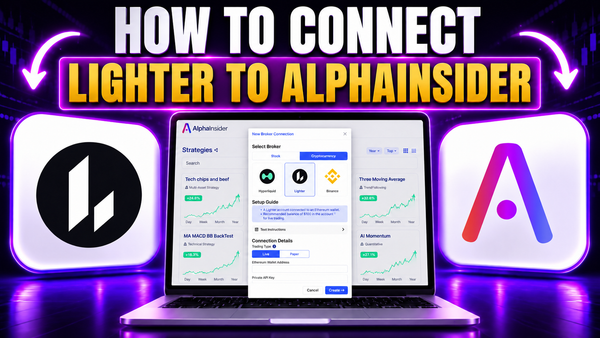
- Click New broker connection and pick a broker matching what you trade — each requires only a $100 minimum, and the connection is verified.
- On the allocation page, set what percentage of your account goes to each strategy — for example, 30% to the first.
- Click New allocations to pull in more strategies from your subscriptions and portfolio — say 30% to one and 40% to another, until your remaining percentage reads zero. Dollar amounts work too.
- Click Save. The bot automatically rebalances: it takes over any live positions and handles every trade that fires from then on.
Now three strategies that do different things share one account — you're diversified, not all-in on a single edge.
Step Four — Manage with Controls
From the bot's page you can:
- Turn the bot on or off whenever you please
- Enable alerts
- Adjust leverage and set maximum slippage per order
- Edit allocations with the pencil icon — drop a strategy from 30% to 20%, add something new you found or built, and save
Step Five — Lock In the Broker Connection
For stocks, Alpaca is currently the best place to automate — it makes third-party trade automation through AlphaInsider genuinely easy. For crypto, the top three right now are Hyperliquid, Bitfinex, and Binance (Hyperliquid may require a VPN in unsupported regions).
One maintenance habit: watch the top of the screen for prompts to update your API keys. Current keys are what keep the flow seamless — strategy fires, signal sent, order placed nearly instantaneously. As long as they're up to date, you're good to go.
Tips & Best Practices
- Expect losing weeks — but know why you lost. Look into which strategies are performing and which aren't, then judge: is this within normal range, or is a strategy falling out of alignment and due for replacement? The alternative — losing money with no verification, no trade history, no data — is exactly what this system eliminates.
- Start hypothetical. Forward test with a paper balance before any live allocation.
- Collect before you build. Subscribing to interesting verified strategies costs nothing and gives you a bench to draw from when allocating.
- Use AI as a strategy factory. Transcribe trading videos, feed them to AI, generate Pine Script, backtest, forward test — the pipeline works end to end.
Common Mistakes to Avoid
- Trusting screenshots. If it isn't independently verified, it isn't evidence.
- Skipping the forward test. A gorgeous backtest can hide repainting, curve fitting, or setup mistakes that only live conditions expose.
- Going all-in on one strategy. Every strategy has cold streaks; concentration turns a cold streak into a catastrophe.
- Running blind with no controls. If you can't pause, adjust, or swap logic quickly, small breaks become long drawdowns.
- Letting API keys go stale. An expired key silently severs the strategy-to-broker pipeline.
FAQ
How hard is it to build a trading bot?
Building the bot itself is no longer the hard part — no-code platforms handle the mechanics. The hard part is getting five inputs right: verification, testing, diversification, controls, and a reliable broker connection. Those determine whether the bot actually works.
Do I need to know how to code?
No. You can subscribe to verified strategies and allocate a bot without writing a line of code. Coding (Pine Script, Python) only comes in if you want to design custom strategies — and even then, AI can generate the code for you to test.
What is forward testing?
Forward testing runs your strategy's exact logic in live market conditions with a hypothetical balance, logging and verifying every trade as it fires. It reveals how the strategy actually trades — not how it hypothetically would have traded in a backtest.
Why isn't a good backtest enough?
Backtests show the past under assumptions you chose, and they can be distorted by repainting, curve fitting, or time-frame mistakes. A forward test catches those problems in live conditions before real money is at risk.
How much money do I need to start?
Broker connections require just a $100 minimum. Forward testing requires nothing at all — you can run it with a hypothetical starting balance.
Which brokers are best for automated trading?
For stocks, Alpaca is currently the easiest to automate. For crypto, Hyperliquid, Bitfinex, and Binance are the top three — though Hyperliquid may require a VPN depending on your location.
Does a verified track record guarantee future profits?
No. Verification proves the performance history is real — it doesn't predict the future. That's exactly why testing, diversification, and controls remain essential.
How long should I forward test before going live?
Long enough to see the logic hold up — a strategy that fires daily builds a meaningful sample in weeks, while one that fires weekly needs months. There's no shortcut, because forward tests run on real market time.
What happens when my bot has a losing week?
Losing weeks are normal. The difference a proper system makes is that you'll know why: you can inspect each strategy's performance, judge whether it's within normal range, and swap in something new if a strategy has fallen out of alignment.
Conclusion
How to build a trading bot that actually works comes down to a mindset shift: stop obsessing over the output and take ownership of the five inputs. Verify every track record you rely on. Forward test your own logic in live conditions. Diversify across strategies that shine at different times. Keep controls in your hands. And connect a broker that executes instantly, every time.
Do that, and your job fundamentally changes — from trying to predict the market to simply managing a system. You'll still have down weeks, but you'll see exactly why, backed by verified data instead of guesswork.
Ready to start? Create your free AlphaInsider account, browse the 5,000+ verified strategies, forward test your first idea, and build a bot you can actually walk away from. And stay tuned — a full series is coming where an entire trading bot gets built with AI, from strategy creation to real money on the line.